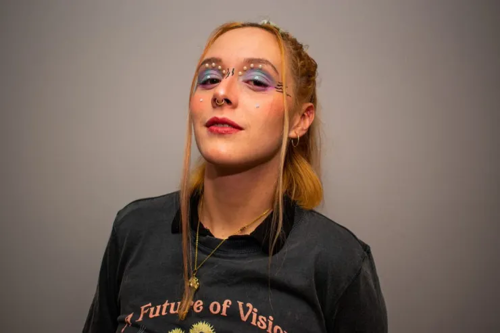
VIP No. 51 Interview with Lucille Dupin

VIP No. 51 Interview with Lucille Dupin
Lucía Agudelo drew inspiration from the renowned French novelist for her pseudonym. A clear nod to the intention behind her entire musical project: feminism. We spoke with her about new songs, the album she hopes to release in 2021, and activism through art.
1. “Julieta” is another single you released this year. It’s a very personal song dedicated to your daughter. How have you approached motherhood creatively and in terms of its redefinition for women?
I must confess that at first I couldn’t find a way to balance motherhood with everything else. I think it’s something all women go through when they face the challenge of resuming their lives after giving birth, because you feel like a stranger even in your own body. But it was precisely with “Julieta” that I was able to resume my artistic work and reconnect with my music, by putting into words and sounds all the emotions and thoughts that accompanied me during pregnancy. Julieta opened a door to a world of creativity, abundance, and newfound sensitivity for me, and along the way, she also helped me redefine what motherhood means to me. Mothers are cruelly told that their lives and projects "end" when they have children, but this is nothing more than a cynical notion masking misogyny. We don't lose any life; rather, a new life begins within us when we have daughters or sons, and their existence always contributes to our processes, especially our creative ones. I believe it's important to talk about this and make motherhood visible, not only in a general sense but also within the artistic sphere, because being a mother shouldn't be synonymous with slavery, but with freedom. Mothering is a profoundly political act. Mothering is resisting the patriarchal impositions that sustain a world where there are no spaces for women or children.
2. Cledón turns one year old next October. What lessons did that EP teach you that influenced the creation of Sibila?
I can't believe it's almost been a year since we released Cledón! How exciting! I recorded Sibila many times, until I found the sound I really wanted to achieve, and Cledón emerged as an experiment where I wanted to capture the journey so far, as well as a nod to a full-length album I wanted to make at one point, where I played with the duality of acoustic and electronic sounds. When I released Cledón, I didn't expect anything more than to compile and publish some of the songs I composed during the creation of Sibila, and I must confess that I was surprised by the great reception it received, since some of these songs weren't even going to be released. Cledón definitely marked a milestone in my career. It showed me that all the work and effort I've put in these years hasn't been in vain, that I'm on the right track, and it also allowed me to give a name and shape to this sound I've been searching for for so long. Cledón was a small experiment that turned out very well, and I'm filled with excitement for what Sibila will be.
3. We've gone more than a year without concerts, festivals, and large-scale shows. How do you think the logic of live events should change to adapt to the new realities?
It's been a very long year. For a while, live streams were the solution, and while they've allowed for a kind of comeback in some successful cases, like the Hermoso Ruido and Altavoz festivals, as an artist, I miss the warmth of the audience, their energy, and the magical interactions that happen in those spaces. Small concerts, on the other hand, can be a way out, allowing artists to reconnect with their audience and return to the stage, creating intimate atmospheres where they interact with the public on a personal level. But after touring in these spaces, I can also say that a reactivation of the entire music ecosystem is urgent. In places where the vaccination process has progressed effectively, there's already talk of returning to massive festivals, and I feel that Colombia is lagging behind in this regard. There's been government neglect of the cultural sector in its handling of the pandemic, which has plunged us into crisis, as many families depend on culture to survive. We need to return to the stage to do our work, and I believe that government neglect leaves much to be desired and much to be done. Open spaces where social distancing can be maintained are a path to a gradual return, as is capacity control, but we need the vaccination of people to be managed, and the issuance of permits to revive the venues we've lost during this difficult pandemic. The innovation that has emerged in the cultural sector to confront the pandemic is admirable, but without public policies, it's difficult to democratize the return to our work in a way that benefits everyone, not just a select few or those who can afford it.
4. Which artists have you discovered during this pandemic period that you would like to recommend?
Well, among the many things, both beautiful and grotesque, that these end-of-the-world times have brought, I must be grateful that I discovered incredible artists like Las Añez, Nicolle Jadad, Bella Álvarez, Ev, Matiu Colin, Buha 2030, and Maria Ambivalente, who stand out among other Colombian projects.