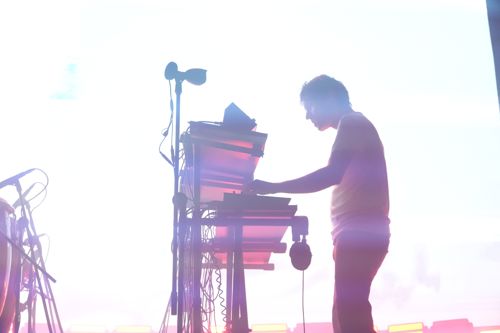
VIP No.1 / 2024 Interview with Julián Salazar from Mitú

VIP No.1 / 2024 Interview with Julián Salazar from Mitú
Over the last decade, Mitú has brought that fine intersection between electronic rhythms and traditional Colombian sounds to dance floors around the world. But what was once a cult duo within the national alternative scene is now in the hands of Julián Salazar, the machine enthusiast who began this new phase with the release of DANZAAA (2024). This change came about as a result of percussionist Franklin Tejedor's decision to devote himself exclusively to promoting the music of his native Palenque, one of the main sources of inspiration for Mitú's sound. We spoke with Julián for this edition of Backstage before he induces us into a trance on November 16 at Páramo Celebra in Bogotá.
1. Although there is only a year between the two works, there is a very important change for Mitú between Astra and DANZAAA. What has it been like to carry out the project entirely on your own? How would you say it has impacted you artistically and personally?
It is definitely a reinvention and has had a notable impact on me, on my approach to making music, and on the music itself. But in the end, it's still what I feel is my path as a musician: total dedication to the circumstances, which in turn fills what one does with honesty. It's a challenge to know that nothing is permanent and that, therefore, we are always rebuilding this kind of immortal work that we sense is there in its raw form and that must be perpetually sculpted.
2. Returning to the subject of these albums, it seems to me that they are an example of these two very distinct sides of Mitú: the songs with lyrics and the party side more linked to live performances, so to speak. What drives you to want to go from one side to the other? How do you approach an electric guitar or a sampler when making an album?
I believe that as long as you are in tune with the music, it will show you the way and how to follow it. That's why concerts are so different for me, even from one night to the next. The flow of things is not always the same, and you have to be attentive to a new development in the piece of music that can manifest itself as a kind of spirit that asks to be interpreted in a slightly or drastically different way from a previous performance. I think that's the most beautiful thing about music: that you always have to create it anew and in the moment because it doesn't tangibly exist.
3. On the subject of live performances, Mitú has always been known for electronic sets, beyond the songs themselves. I understand that you are also doing something a little more dissonant with some Moogs at the moment. How would you explain to someone who is not an expert in all this machinery what Mitú is like live today?
I think Mitú is still very faithful to its starting point. It's music made mainly with electronic media with a raw sound. The media I've used, the instruments, have changed over the years, but now I'm trying to go for a minimalist approach with the instrument I started out with (Moog) and avoid polyphony, a kind of purism of synthesis in which dissonance and the raw manifestations of the machine itself are valid.
4. Mitú is a project that originated in Bogotá, but with influences from the Caribbean. Synthetic and analog. It has musical influences from all over Latin America but is nourished by your tours in Europe. How do you feed yourself creatively today?
When I look for musical nourishment, my main source is fasting. In other words, I don't listen to anything.
5. Finally, I would like to ask you to recommend a Latin American artist who is resonating with you today.
What has resonated with me the most these days is Meridian Brothers. Eblis is a genius. The latest album is a gem.
Interview by Eduardo Santos